

This is the link to my map:
http://maps.google.com.au/maps/ms?msid=214135285069564205031.0004b25e07d65b35c1554&msa=0&ll=-33.592851,151.329589&spn=0.020412,0.042272&iwloc=0004b2c2cc67069ca7e8a
Subscribe To Cams Geography Blog

 Posts
All Comments
Posts
All Comments
Thursday, December 1, 2011

Thursday, October 27, 2011
Big Waves profile
Mavericks
Mavericks is a surfing location in Northern California, U.S.A.. It is located approximately 3.2 km off shore in Pillar Point Harbor just north of Half Moon Bay. After a strong winter storm in the northern Pacific Ocean, waves can routinely crest at 8m high and top out at over 24.4m. The break is caused by an unusually-shaped underwater rock configuration.
Mavericks is shown below:
View Larger Map
Mavericks is famous for extremely large waves. In a recent study, conducted by the US National Oceanic and Atmospheric Administration in 2007, results revealed that a long, sloping ramp leads up to the surface under the wavebreak, and because of this ramp slows the movement of the wave over it. The wave over the deep water troughs on each side of the ramp continues at incredible speeds, forming two angles in the wavefront centered over each of the boundaries between the ramp and the two troughs. This turns the waves into an almost 'U' or 'V'-shaped wavefront on the ramp that contains the wave energy from the full width of the ramp. This U or V-shaped wave then collapses with extreme force.

As seen above, you can see how the winds and the tide gradually get faster and stronger as they come into the shore. These tides and winds are a huge ingredient in the creation of these incredible waves.
The end result is the creation of incredible waves that are visited by hundreds to thousands of people annually.

Tuesday, October 25, 2011
7.2


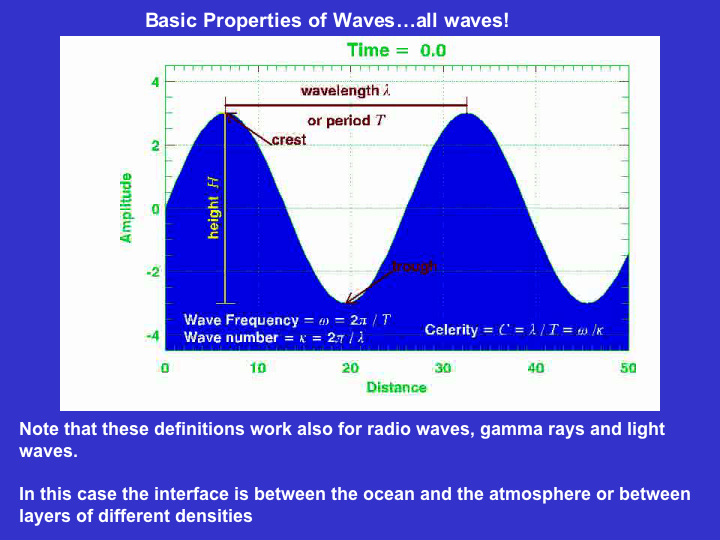
- The wind is what causes waves. At first it starts with ripples, then those form wavelets and then waves.
- The distance the wind travels over the ocean to form waves it known as fetch.
- Waves in the open ocean don't break because they are higher up on the ocean seabed, but when they reach the shore they release there energy and break.
- Spilling waves are waves that break far from the beaches, meaning that body boarders can body board because they are safe from hitting anyone. Plunging waves are waves that break on the beach creating barrels. And surging waves are waves that just wash up, there are no breaks and its just a gental wave that rolls up the beach, creating erosion.
- Wind swells are when the wind hits the water and greats waves that are close to the shore. These waves occur more frequently because they are close to the shore. Ground waves are a lot less frequent and occur way out in the ocean, creating bigger waves.
- There are three types of waves that you must look out for, so if you want to find the best ones, you need to know what ones you like. There are spilling waves, which break on the shores, best for body boarding and swimming. Plunging waves, which are the best for surfers because there are barrels. And then there's surging waves which are flat waves which no breaks.
7.1
- The pressure of urban development along the coastline has caused a range of geographical issues involving various groups. Residents, tourists and commercial-related activities all need to be managed by geographers so that the development of the coastline is sustainable.
- The trend that has been labeled 'Sea Change' is were people have decided to move from larger cities to populate smaller coastal towns.
- The government has put a cap on the amount of people who can populate certain coastal areas.
- Pollution;
- Tourism;
- Introduction;
- Inappropriate develop;
- geographers are the developers of these management solutions for the issues plaguing our coastal environments.
- My name is Campbell Fisher and I have just moved into the new beach front apartments on the coast. I have loved my time here and love the view, but that was what I wanted to talk about, the view. I have seen the people in town look at my apartment blocks with anger and frustration, I realized that they feel as if these apartments should not be here and unfortunately I feel the same way. I find two problems with these apartments, the risks of living so close to the beach with global warming and seas rising, also the surface these buildings are over. If they are so close to the beach, they cannot be stable. I would very much appreciate it if you would post my comments in your next addition of your morning paper. Kind regards, Campbell.
Monday, September 5, 2011
Source A-C
1. What is the predicted population growth rate in 2030?
0.7 percent
2. What is the predicted population change in 2030?
50 million
3. What region of the world is predicted to have the greatest gross increase in percentage between 1800 and 2050?
Africa
Source D
1. How many males and females are there in Ethiopia for the age range 60-64 in the year 2000?
2.3 million
2. How many males and females are there in Italy for the age range 60-64 in the year 2000?
3.8 million
3. Why do you think that there is such a difference between these two countries?
Italy has a higher standard of health, and is known as a popular place, so will be a place where alot of people will be happy to have children.
Source E
1. What is located at GR831979?
Dicks hill
2. What is the highest point at AR7997?
400
3. What is the contour interval for the map?
10 metres
4. What physical feature is located at GR820975?
Wet swamp
5. Approximately how far is the Laurieton Sporting Complex from Hanleys Point on the Camden Haven Inlet?
1.1kms
6. Give the GR for the North Haven Public School.
GR830000
What is the highest point at Camden Head? Give the height and GR.
Hamey lookout. Height of 79. GR848987
1. What is the predicted population growth rate in 2030?
0.7 percent
2. What is the predicted population change in 2030?
50 million
3. What region of the world is predicted to have the greatest gross increase in percentage between 1800 and 2050?
Africa
Source D
1. How many males and females are there in Ethiopia for the age range 60-64 in the year 2000?
2.3 million
2. How many males and females are there in Italy for the age range 60-64 in the year 2000?
3.8 million
3. Why do you think that there is such a difference between these two countries?
Italy has a higher standard of health, and is known as a popular place, so will be a place where alot of people will be happy to have children.
Source E
1. What is located at GR831979?
Dicks hill
2. What is the highest point at AR7997?
400
3. What is the contour interval for the map?
10 metres
4. What physical feature is located at GR820975?
Wet swamp
5. Approximately how far is the Laurieton Sporting Complex from Hanleys Point on the Camden Haven Inlet?
1.1kms
6. Give the GR for the North Haven Public School.
GR830000
What is the highest point at Camden Head? Give the height and GR.
Hamey lookout. Height of 79. GR848987
Are we a racist nation?
Who is the author and what is his job title?
Graeme Innes, he is a race discrimination commissioner.
Who does he work for and what is supposed to do in this job?
He is a Race Discrimination Commissioner, he is supposed to protect all people from racial discrimination and ensure everyone has equality.
What does the author say is often the beginning of a racist comment?
I am not a racist, but...
Have you every heard anyone use this line to say something racist? If so, what did they say?
No I haven't
What percent of Australians are born overseas or have an overseas parent?
50% of all Australians are born overseas or have overseas parents.
What is a 'monoculture'?
Monoculture is the belief of one race being dominant or in control, systems that have very low diversity.
What are some welcome benefits of online technology?
They also have connected the world's indigenous peoples, as well as ethnic minority groups, in a way they have never been connected before - to share stories, co - ordinate their work, and collectively organize.
What are some unwelcome results of online social media?
However, they can also be used to cause serious harm. The proliferation of race - hate websites and materials breeds and incites real world hatred. And our cyber - racism complaints have more than doubled in the past couple of years. Racism online means that in our classrooms, workplaces and communities moves into our pockets and handbags.
What makes racism online so dangerous?
Racism online is so dangerous as you may not know that you are offending someone. On the other hand you may not be able to escape the bullying as when you come home and finally escape the racial slur, when you come home they are practiclly waiting for you.
What will help stop racism online?
The way that we can stop racism online is by having a parental watcher over the website able to view everything being written online. If you know that a parent is sitting on a computer reading everything you type, personally that would make me not want to say a word wrong.
What does the author suggest we need to do to stop racism?
We need to act together, without delay, to erdaicate racism and racial inequality in all of its forms - to find a solution. This is a real zero - tolerance approach, not a "zero acknowledment' approach.
Graeme Innes, he is a race discrimination commissioner.
Who does he work for and what is supposed to do in this job?
He is a Race Discrimination Commissioner, he is supposed to protect all people from racial discrimination and ensure everyone has equality.
What does the author say is often the beginning of a racist comment?
I am not a racist, but...
Have you every heard anyone use this line to say something racist? If so, what did they say?
No I haven't
What percent of Australians are born overseas or have an overseas parent?
50% of all Australians are born overseas or have overseas parents.
What is a 'monoculture'?
Monoculture is the belief of one race being dominant or in control, systems that have very low diversity.
What are some welcome benefits of online technology?
They also have connected the world's indigenous peoples, as well as ethnic minority groups, in a way they have never been connected before - to share stories, co - ordinate their work, and collectively organize.
What are some unwelcome results of online social media?
However, they can also be used to cause serious harm. The proliferation of race - hate websites and materials breeds and incites real world hatred. And our cyber - racism complaints have more than doubled in the past couple of years. Racism online means that in our classrooms, workplaces and communities moves into our pockets and handbags.
What makes racism online so dangerous?
Racism online is so dangerous as you may not know that you are offending someone. On the other hand you may not be able to escape the bullying as when you come home and finally escape the racial slur, when you come home they are practiclly waiting for you.
What will help stop racism online?
The way that we can stop racism online is by having a parental watcher over the website able to view everything being written online. If you know that a parent is sitting on a computer reading everything you type, personally that would make me not want to say a word wrong.
What does the author suggest we need to do to stop racism?
We need to act together, without delay, to erdaicate racism and racial inequality in all of its forms - to find a solution. This is a real zero - tolerance approach, not a "zero acknowledment' approach.
Australias population
- What is demography?
The study of statistics such as births, deaths, income, or the incidence of disease, which illustrate the changing structure of human populations
- In what year did the Australian population reach 20 million? How quickly is the population growing?
September 4th 2003
- How many Aboriginal people are estimated to have lived in Australia before Europeans arrived?
- What the two main ways the population can grow? What percentage of the population growth in 2010 can be attributed to each way?
- What is the total fertility rate for 2010?
Fertility rate in 2010 (births/woman) is 1.78 - What was the total fertility rate for Australia in 1935? How does this compare to other years? Why do you think that it compares this way?
It was 2.1, The great depression was occurring in that time.
- What is the trend in the fertility rate for Australia since 1950?
The trend is overall reclining, 2008 the baby bonus made it jump a little, yet now it is back to reclining. - What is the average size of a family in Australia? How does that compare to the US?
The average size of an Australian family is 2.6 and compared to the US they have 2.59
Subscribe to:
Posts (Atom)