

This is the link to my map:
http://maps.google.com.au/maps/ms?msid=214135285069564205031.0004b25e07d65b35c1554&msa=0&ll=-33.592851,151.329589&spn=0.020412,0.042272&iwloc=0004b2c2cc67069ca7e8a
Subscribe To Cams Geography Blog

 Posts
All Comments
Posts
All Comments
Thursday, December 1, 2011

Thursday, October 27, 2011
Big Waves profile
Mavericks
Mavericks is a surfing location in Northern California, U.S.A.. It is located approximately 3.2 km off shore in Pillar Point Harbor just north of Half Moon Bay. After a strong winter storm in the northern Pacific Ocean, waves can routinely crest at 8m high and top out at over 24.4m. The break is caused by an unusually-shaped underwater rock configuration.
Mavericks is shown below:
View Larger Map
Mavericks is famous for extremely large waves. In a recent study, conducted by the US National Oceanic and Atmospheric Administration in 2007, results revealed that a long, sloping ramp leads up to the surface under the wavebreak, and because of this ramp slows the movement of the wave over it. The wave over the deep water troughs on each side of the ramp continues at incredible speeds, forming two angles in the wavefront centered over each of the boundaries between the ramp and the two troughs. This turns the waves into an almost 'U' or 'V'-shaped wavefront on the ramp that contains the wave energy from the full width of the ramp. This U or V-shaped wave then collapses with extreme force.

As seen above, you can see how the winds and the tide gradually get faster and stronger as they come into the shore. These tides and winds are a huge ingredient in the creation of these incredible waves.
The end result is the creation of incredible waves that are visited by hundreds to thousands of people annually.

Tuesday, October 25, 2011
7.2


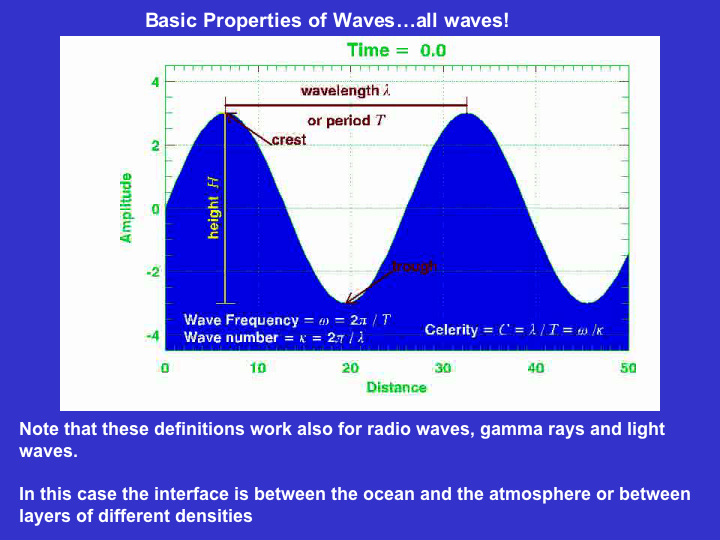
- The wind is what causes waves. At first it starts with ripples, then those form wavelets and then waves.
- The distance the wind travels over the ocean to form waves it known as fetch.
- Waves in the open ocean don't break because they are higher up on the ocean seabed, but when they reach the shore they release there energy and break.
- Spilling waves are waves that break far from the beaches, meaning that body boarders can body board because they are safe from hitting anyone. Plunging waves are waves that break on the beach creating barrels. And surging waves are waves that just wash up, there are no breaks and its just a gental wave that rolls up the beach, creating erosion.
- Wind swells are when the wind hits the water and greats waves that are close to the shore. These waves occur more frequently because they are close to the shore. Ground waves are a lot less frequent and occur way out in the ocean, creating bigger waves.
- There are three types of waves that you must look out for, so if you want to find the best ones, you need to know what ones you like. There are spilling waves, which break on the shores, best for body boarding and swimming. Plunging waves, which are the best for surfers because there are barrels. And then there's surging waves which are flat waves which no breaks.
7.1
- The pressure of urban development along the coastline has caused a range of geographical issues involving various groups. Residents, tourists and commercial-related activities all need to be managed by geographers so that the development of the coastline is sustainable.
- The trend that has been labeled 'Sea Change' is were people have decided to move from larger cities to populate smaller coastal towns.
- The government has put a cap on the amount of people who can populate certain coastal areas.
- Pollution;
- Tourism;
- Introduction;
- Inappropriate develop;
- geographers are the developers of these management solutions for the issues plaguing our coastal environments.
- My name is Campbell Fisher and I have just moved into the new beach front apartments on the coast. I have loved my time here and love the view, but that was what I wanted to talk about, the view. I have seen the people in town look at my apartment blocks with anger and frustration, I realized that they feel as if these apartments should not be here and unfortunately I feel the same way. I find two problems with these apartments, the risks of living so close to the beach with global warming and seas rising, also the surface these buildings are over. If they are so close to the beach, they cannot be stable. I would very much appreciate it if you would post my comments in your next addition of your morning paper. Kind regards, Campbell.
Monday, September 5, 2011
Source A-C
1. What is the predicted population growth rate in 2030?
0.7 percent
2. What is the predicted population change in 2030?
50 million
3. What region of the world is predicted to have the greatest gross increase in percentage between 1800 and 2050?
Africa
Source D
1. How many males and females are there in Ethiopia for the age range 60-64 in the year 2000?
2.3 million
2. How many males and females are there in Italy for the age range 60-64 in the year 2000?
3.8 million
3. Why do you think that there is such a difference between these two countries?
Italy has a higher standard of health, and is known as a popular place, so will be a place where alot of people will be happy to have children.
Source E
1. What is located at GR831979?
Dicks hill
2. What is the highest point at AR7997?
400
3. What is the contour interval for the map?
10 metres
4. What physical feature is located at GR820975?
Wet swamp
5. Approximately how far is the Laurieton Sporting Complex from Hanleys Point on the Camden Haven Inlet?
1.1kms
6. Give the GR for the North Haven Public School.
GR830000
What is the highest point at Camden Head? Give the height and GR.
Hamey lookout. Height of 79. GR848987
1. What is the predicted population growth rate in 2030?
0.7 percent
2. What is the predicted population change in 2030?
50 million
3. What region of the world is predicted to have the greatest gross increase in percentage between 1800 and 2050?
Africa
Source D
1. How many males and females are there in Ethiopia for the age range 60-64 in the year 2000?
2.3 million
2. How many males and females are there in Italy for the age range 60-64 in the year 2000?
3.8 million
3. Why do you think that there is such a difference between these two countries?
Italy has a higher standard of health, and is known as a popular place, so will be a place where alot of people will be happy to have children.
Source E
1. What is located at GR831979?
Dicks hill
2. What is the highest point at AR7997?
400
3. What is the contour interval for the map?
10 metres
4. What physical feature is located at GR820975?
Wet swamp
5. Approximately how far is the Laurieton Sporting Complex from Hanleys Point on the Camden Haven Inlet?
1.1kms
6. Give the GR for the North Haven Public School.
GR830000
What is the highest point at Camden Head? Give the height and GR.
Hamey lookout. Height of 79. GR848987
Are we a racist nation?
Who is the author and what is his job title?
Graeme Innes, he is a race discrimination commissioner.
Who does he work for and what is supposed to do in this job?
He is a Race Discrimination Commissioner, he is supposed to protect all people from racial discrimination and ensure everyone has equality.
What does the author say is often the beginning of a racist comment?
I am not a racist, but...
Have you every heard anyone use this line to say something racist? If so, what did they say?
No I haven't
What percent of Australians are born overseas or have an overseas parent?
50% of all Australians are born overseas or have overseas parents.
What is a 'monoculture'?
Monoculture is the belief of one race being dominant or in control, systems that have very low diversity.
What are some welcome benefits of online technology?
They also have connected the world's indigenous peoples, as well as ethnic minority groups, in a way they have never been connected before - to share stories, co - ordinate their work, and collectively organize.
What are some unwelcome results of online social media?
However, they can also be used to cause serious harm. The proliferation of race - hate websites and materials breeds and incites real world hatred. And our cyber - racism complaints have more than doubled in the past couple of years. Racism online means that in our classrooms, workplaces and communities moves into our pockets and handbags.
What makes racism online so dangerous?
Racism online is so dangerous as you may not know that you are offending someone. On the other hand you may not be able to escape the bullying as when you come home and finally escape the racial slur, when you come home they are practiclly waiting for you.
What will help stop racism online?
The way that we can stop racism online is by having a parental watcher over the website able to view everything being written online. If you know that a parent is sitting on a computer reading everything you type, personally that would make me not want to say a word wrong.
What does the author suggest we need to do to stop racism?
We need to act together, without delay, to erdaicate racism and racial inequality in all of its forms - to find a solution. This is a real zero - tolerance approach, not a "zero acknowledment' approach.
Graeme Innes, he is a race discrimination commissioner.
Who does he work for and what is supposed to do in this job?
He is a Race Discrimination Commissioner, he is supposed to protect all people from racial discrimination and ensure everyone has equality.
What does the author say is often the beginning of a racist comment?
I am not a racist, but...
Have you every heard anyone use this line to say something racist? If so, what did they say?
No I haven't
What percent of Australians are born overseas or have an overseas parent?
50% of all Australians are born overseas or have overseas parents.
What is a 'monoculture'?
Monoculture is the belief of one race being dominant or in control, systems that have very low diversity.
What are some welcome benefits of online technology?
They also have connected the world's indigenous peoples, as well as ethnic minority groups, in a way they have never been connected before - to share stories, co - ordinate their work, and collectively organize.
What are some unwelcome results of online social media?
However, they can also be used to cause serious harm. The proliferation of race - hate websites and materials breeds and incites real world hatred. And our cyber - racism complaints have more than doubled in the past couple of years. Racism online means that in our classrooms, workplaces and communities moves into our pockets and handbags.
What makes racism online so dangerous?
Racism online is so dangerous as you may not know that you are offending someone. On the other hand you may not be able to escape the bullying as when you come home and finally escape the racial slur, when you come home they are practiclly waiting for you.
What will help stop racism online?
The way that we can stop racism online is by having a parental watcher over the website able to view everything being written online. If you know that a parent is sitting on a computer reading everything you type, personally that would make me not want to say a word wrong.
What does the author suggest we need to do to stop racism?
We need to act together, without delay, to erdaicate racism and racial inequality in all of its forms - to find a solution. This is a real zero - tolerance approach, not a "zero acknowledment' approach.
Australias population
- What is demography?
The study of statistics such as births, deaths, income, or the incidence of disease, which illustrate the changing structure of human populations
- In what year did the Australian population reach 20 million? How quickly is the population growing?
September 4th 2003
- How many Aboriginal people are estimated to have lived in Australia before Europeans arrived?
- What the two main ways the population can grow? What percentage of the population growth in 2010 can be attributed to each way?
- What is the total fertility rate for 2010?
Fertility rate in 2010 (births/woman) is 1.78 - What was the total fertility rate for Australia in 1935? How does this compare to other years? Why do you think that it compares this way?
It was 2.1, The great depression was occurring in that time.
- What is the trend in the fertility rate for Australia since 1950?
The trend is overall reclining, 2008 the baby bonus made it jump a little, yet now it is back to reclining. - What is the average size of a family in Australia? How does that compare to the US?
The average size of an Australian family is 2.6 and compared to the US they have 2.59
Sunday, September 4, 2011
Go Back to Where You Came From Reflection
- What is your initial reaction to the show?
My initial reaction to the show is that it is quite graphic and that it's very revealing
- What percentage of immigrants are refugees?
1.5%
- Why does such a small number of people make for such a big deal both politically and in the media? (Give your opinion)
The whole refugee journey and experiance is not something that many people want to do, and this is understandable as it is a journey full of the unexpected and for many even death.
- Where does Australia rank among countries accepting refugees?
18th
- To what extent do we have an obligation to help other people suffering in the world? (your opinion)
To some extent we do actually have to help fellow members of our race, but we can't help everyone, we need to still be able to take care of ourselves.
- How much extra support do refugees receive in comparison to other Australian citizens?
They receive the same
- How many Asian nations have signed the UN Refugee Convention?
11
- Why is it important to note that Malaysia has not signed the UN Refugee Convention? What does this mean for refugees in Malaysia?
It is important because they are a place were many of the refugees go.
Tuesday, May 31, 2011
How many parts of the project have you complete?
Tuesday, May 10, 2011
- A flood is an area of that is severely covered in typically rain water.
- Flash flooding is when small rivers or streams over flow and urban areas are vulnerable because they have more streams near there main township which will cause flooding of the streets, business and residential areas
- flooding varies between inland and coastal but some land is flat and some have more soil
- 3 impacts floods have on communities is that land is very hilly, and there for allow water to pool, they are usually very confined, most houses and buisneses are in the same place which means that if one place gets flooded they all do.
- the environmental factors that caused the 1998 floods is that flooding in that area is alot higher than in the area of the 2006 floods
- an economic factor that was on the katherine community is that there were lots of rivers an social one is lives were lost
a) The gradient of each river is that the river was slowb) Graqdient was a lot higher in the inland riverc) Flooding clears in days because of sedimentation- Damns force the water level to rise
- The brochure warning of flash flooding would have on it to go outside and go to higher ground to stay safe
- The impact of the flood in katherine is that there were a lot of rivers and streams casing the river to rise
2.3
- A severe storm is characterised by lightning and thunder, and is defined as one which produces any or all of the following:
- hail with a diameter of 2 centimetres or more
- wind gusts of 90 kilometres per hour or more
- flash flooding
- tornados. - Aspects that present risk to human life are, flash floods, lightneing and hail.
- The atmospheric conditions that cause severe storms typically develop when warm humid air is pushed upward into the atmosphere by converging surface winds
- Latent heat pushes clouds up higher into the atmosphere where they cool rapidly and ice crystals form.
- Hail tends to form higher up in the atmosphere about 12 kilometers high where the water freezes and hail forms
- A tornado will generally form up in the clouds
- The Australian Bureau of Meteorology, Weather warnings are devolped by weather instruments that are placed around cities.
- Sevre storms are still highly unpredictable accourances because they can apear anywhere at any time extremely quickly, giving no warning.
a) It was issued at 1:14 PM Monday, 13 November 2006.
b) Greater Newcastle and Maitland/Cessnock areas
c) the next storm warning to be published was 2:10pm
d) the actions i would recommend to protect lives is to put everyone inside and stay down
Tuesday, May 3, 2011
2.2 Questions
- A landslide or landslip is a geological phenomenon which includes a wide range of ground movement, such as rock falls, deep failure of slopes and shallow debris flows, which can occur in offshore, coastal and onshore environments.
- Landslides can be triggered by natural causes like heavy rainfall saturating the soil, vibrations from earthquakes or undercutting of banks and cliffs from waves or rivers.
- Human actions cause almost half of the landslides in Australia. Construction of roads and railways on hillsides along with building works can weaken hillsides and make them more vulnerable during heavy rainfall. Mining activities also contribute to the hazard.
- The cause of earthquakes in Australia is intra-plate tension where movements occur along cracks and faults in the Earth’s crust, and are measured be the Richter scale
- The main causes of earthquakes in Australia is Intra-plate tension where movements occur along cracks and faults in the Earth’s crust
- Australia has earthquakes measuring 5.5 on the richtor scaled approxamitly every 15 months, and it doesn’t cause much damage as Australia is on a tectonic plate not next to one.
- The Newcastle earthquake killed 13 people and injured 120. It also impacted on buildings, with 35 000 homes and 3000 other buildings being moderately to seriously damaged in Newcastle, and a total of 70 000 buildings in the region sustaining minor damage.
- The difference between a landslide and an earthquake is that a landslide shifts material on top of the ground, where an earthquake shakes the ground from underneath.
- A Tsunami is a massive wave which is cause by an earthquake which occours under the sea.
- An earthquake, landslide or volcano occurs under the sea it can trigger a tsunami.

13. A 9.3 Richter scale Earthquake off the west coast of Sumatra
14. There are 23 automated earthquake monitoring stations. It took these stations 20 minutes to pick up the earthquake.
15. The Tsunami grows taller and wider but slows down dramatically.
16. The United Nations developed a Tsunami warning system for the Indian Ocean.
17. Ted Bryant is a Wollongong University geoscience professor that has warned that Tsunami’s caused by New Zealand’s Alpine Fault could strike New South Wales as often as every 500 years.
18. 18. A) 15 degrees North and 90 degrees East
B)
i) 2 hours
ii) 10 hours
iii) 4.5 hours
iv)9 hours
i) 2 hours
ii) 10 hours
iii) 4.5 hours
iv)9 hours
19.We are at Thredbo after just 4 hours ago, a devastating landslide swept everything away that got in the way of it's unmerciful hands. Approximately 3500 tonnes of dirt and derbies came tumbling down the once blemished ski slopes destroying the Bimbadenn and Carinya Lodges, and leaving a death toll of 18 people. This has majorly affected the ski slopes and mountains that Thredbo exploits as its main source of income, as they have been closed due to the landslide and the damages that have been caused.

Monday, May 2, 2011
Deadly storms in US
- The death toll, including those who were killed by storms earlier in the week in Arkansas, reached 333. On Friday evening, Alabama emergency officials announced that the state’s death toll had reached 232.
- Power remained out for hundreds of thousands throughout the South, rendering gas stations, grocery stores and banks useless. Fifteen hundred people were staying in more than 65 Red Cross shelters, a fraction of those who were left homeless but an indication of the numbers who are now destitute.
- So far in Alabama, 654 families have been displaced from public or government-assisted housing units, according to an initial count by the federal Department of Housing and Urban Development.
- Insurance claims are already growing exponentially, and could approach $1 billion
Social effects of a heat wave
- A clear outcome of heat waves is a rapid rise in mortality. When a heat wave strikes communities can sometimes lose a mass of people through environmental and just simply the effects resulting from the extreme heat.
- Excessive heat which comes from heat waves and droughts causes psychological stress, to a degree which affects performance, and is also associated with an increase in violent crime.
- Extreme heat can cause diverse problems with health. Heat waves usually cause mass dehydration which can cause a long list of problems.
- Heat waves also effect transport, through speed reductions on rail networks and the deterioration of surfaces on roads that have not been resealed following new standards for asphalting.
Tuesday, April 26, 2011
2.1 Natural hazards in Australia
- A natural hazard is a threat of a naturally occurring event that will have a negative effect on people or the environment.
- The difference between a natural disaster and a natural Hazard is that a natural disaster causes a threat to economical and social society were as a natural hazard happens which may lead to a disaster
- the two catergories of natural hazards in Australia are the ones that cause changes in weather, and those that cause movement in the earths crust
- weather and climatic factors—drought, flood, heatwaves, bushfires, strong winds, storms, tropical cyclones and tornadoes
movements in the Earth’s crust— landslides, earth tremors, earthquakes and tsunamis. - Natural hazards that occur in more densly populated areas are more noticable then those that occur in other parts of Australia because the impacts they have on communities are obvious and costly. They become well documented and covered by the media because of the effects on a large number of people.
- Droughts have large effects on all communities anywere in the world, though they impact more greatly in rural areas because it is already hard for them to reach water, and they will need to get water from other locations
- Social impacts—loss of life, and stresses placed on families and people, as well as the destruction of community structures and facilities.
Economic impacts—such as the loss of income for people or damage to an industry, loss and destruction of property, and insurance losses.
Environmental impacts—including the destruction of the natural and human environment, death of and injury to wildlife, and changes to environments. - It is important because more of the Australian continent is settled exposing communities to a greater range of threats.
- GIS is used to map the threat of natural hazards in Australia by using past natural hazards and disasters and calculating the likely hood of it happening in a certain area by the amount of times a certain place has experienced natural hazards.
(a) Tsunami, Flood, Bushfire
B) Heatwave
A) Local councils could make certain restrictions about things that may be negative towards the community during a natural hazard
B)The state government can learn which parts of the state are most at risk to natural hazard and spend more money protecting and preparing those areasC) They know where the higher risk places are, so they can patrol or station themselves closer to that area
D) Insurance companies would be able to save money by restricting some of their policies to people that live in high risk areas
Tuesday, March 22, 2011
1.11
- Coal, Oil, Natural Gas
- Hydroelectric Power, Solar Power, Wind Power,
- To counteract climate change or "Global Warming" without having serious negative impacts on the community
- Australia, China, The United States and India
- Australia's coal reserves have about 76 billion tonnes in them
- Australia's natural gas reserves have remained relatively untapped over the years because of the abundance and demand of coal and oil
- The solar power plant being built near Mildura will have technology to power satellites and consists of fields of mirrors each covering 0.8 kilometres.
- Large turbines are situated on poles, and when the wind pushes and turns them it generates electricity
- PositiveNegativeIt supplies energy to 18000 homesThe farm cost $65 millionWill reduce greenhouse gas emissions by two million tonnes over 25 yearsThese turbines measures 100 metres in length and has to have a 25 kilometre transmission line to get power to Yankalilla, the distribution network
- Hydro, Solar and Wind power are good because they give out the same amount of power and electricity for less cost and leaves a smaller carbon footprint. Solar power allows us to draw power from the sun and is very cost-effective. Hydro power allows us to draw power from water and supply houses with electricity. Wind power uses wind to generate electricity. 2 out of the 3 things I listed are unlimited, Solar and Wind, so this could last us for hundreds of years if not longer.
- All of the pipelines that are currently built and operating are very close to Natural Gas production basins, inland for the east coast, out to sea for the west coast. These pipelines also travel to all the major cities in Australia, such as Sydney, Perth and Brisbane.
A) i)$16.8 billion ii)$5.2 billion iii)$3.1 billion
B) i)$25 billion ii)$6.5 billion iii)$3 billion
C) Coal
1. Resources are any physical or virtual entity that are of limited availability, or anything used to help someone earn a living. In most cases, commercial or even ethic factors require resource allocation through resource management.
2. A renewable resource is a natural way of making energy such as, wind power or hydroelectricity, it is something that leaves the material you used in the same form. Were non renewrable resources are like coal being bunt, it releses Co2 into the attmosphire, and the coal is changed.
3. A renewable resource can become non renewable through over exploitation
4. Soil is an important resource because it is the basis for agricultural activities.
5. Silviculture is the branch of forestry dealing with the development and care of forests
6. It is 164.4 million hectares
7. Australia’s fishing and aquaculture industries are worth more than $2 and they are extremely valuable
8. The Australian Fisheries Management Authority (AFMA) set a limit of 5265 tonnes for the southern blue fin tuna catch in 2006.
9. Bauxite, iron ore, lead, zinc, silver, uranium, industrial diamonds and mineral sands.
10. Australia’s mineral reserves are increasing because of the ever growing demand of the mineral reserves in which we export.
11. Australias forest resources are incredibly large, they cover over 164 million hectares. Australia in an incredibly large country, and the forest occupies 21% of it. The forest provides masses of resources to the Australian people. Yet not all the forest is native, actually 1.7 million hectares isn’t native. Over $20 million dollars a year comes from exports of wood products.
12. Uranium is a valuable source as nuclear fuel for nuclear power reactors. The nuclear energy has no contribution to global warming and is an alternative to fossil fuels.
13. World heritage sites are valuable resources because they are of great significance on a national and global scale, and so bring tourists that are associated economics benefits.
14. Uranium mining could have a major effect on the landscape because it requires lots of different machines to makes sure that people mine it correctly and without hazard, so large spaces of the Australian country side are effected.
15. The Australian fishing grounds are all around Australia, mainly on the east coast
16.
A) Many of the mines are spread out around Australia, mainly congregating in the Northern Territory.
B)Radium Hill
C) Ranger
A) Many of the mines are spread out around Australia, mainly congregating in the Northern Territory.
B)Radium Hill
C) Ranger
17.

A)
i) 399 million,
ii) 237 million
iii) 528 million
B)
i) 437.3 million
C) The value of uranium has definitely increased as demand increases and as nuclear technology (weapons, power) evolves.
Tuesday, March 8, 2011
1.7
1. Australia has been isolated for over 50 million years, so as a result the fauna and flora have evolved differently to the other species in different continents of the world.
2. Because of the stability of the environment, and the respect the native aboriginals had for the land species in Australia have lived succsefuly for millions of years
3. Endemic means something that is not found anywhere else in the world.
4. Around 89% of Australian reptiles are endemic.
5. The South-west Botanical Province of Western Australia and The Great Barrier Reef, The Tropical Rainforest
6. The Tropical Rainforest
7. Marsupials are mammals that have pouches, like Kangaroos, and Wombats
8. Monotremes are egg laying mammals . Example, Duck Billed Platypus
9. The are very minute differences between the Kangaroo, and the Wallaby. The wallaby is smaller then the Kangaroo, and enjoys rugged terrain where as the Kangaroo enjoys long grassed areas.
10. The platypus is a semi-aquatic mammal endemic to eastern Australia. It is one of the five extant species of monotremes, the only mammals that lay eggs instead of giving birth to live young. It is one of the most peculiar Australian animals, and for along time scientists weren't not sure how to classify it.

11. Banksia marginata, commonly known as Silver Banksia, is a species of tree or woody shrub in the plant genus Banksia. it reaches up to 8 m tall. It occurs throughout the south east corner of Australia, from the Eyre Peninsula in South Australia, to north of Armidale, New South Wales, including Tasmania, Flinders Island and King Island.
Monday, March 7, 2011
1.5
- The three main land regions of Australia are; Western Plateau, Central Lowlands and Eastern Highlands.
- The Australian alps are in Victoria
- The mountains in the Australian alps are rounded because they are extremely old and they have been subjected to erosion for over 860 million years
- Uluru is located in the very south-west corner of the Northern Territory.
- Uluru which is also known as Ayers Rock, is a large sandstone rock formation in the southern part of the Northern Territory, central Australia. Kata Tjuta and Uluru are the two major features of the Uluṟu-Kata Tjuṯa National Park. Uluru is sacred to the Pitjantjatjara and Yankunytjatjara, the Aboriginal people of the area. It has many springs, waterholes, rock caves and ancient paintings. Uluru is listed as a World Heritage Site.
- In the middle of the day the Sun’s rays pass through less thickness of atmosphere so less of the blue light is filtered. Where as at sunrise and sunset, the Sun’s rays pass through a greater thickness of atmosphere; therefore, more of the blue light is filtered, giving it a really red colour
- A drainage basin is an area of land where surface water from rain meet at a single point, usually the exit of the basin, where the waters join another waterbody, such as a river, lake, reservoir, estuary, wetland, sea, or ocean.
- The two largest drainage basins in Australia are; Lake Eyre and the Murray - Darling basin.
- The three largest rivers in Australia are; the Murray River, Murrumbidgee River and the Darling River.
- The water in lake Eyre basin flows down to Lake Eyre, although most of the water is actually lost through evaporation
- Finke River is unusual because it only flows a few days each year, also most of the water is lost to evaporation through the Simpson Desert, and it's believed that water flowing through it has only reached Lake Eyre once in the last century.
- The Fraklin river is located in the south-west area of Tasmania. It has become synonymous with conversation because of the ‘Battle to Save the Franklin’ campaign which rescued it from being dammed for hydro-electric power in the 1980s. The campaign by the Tasmanian Wilderness Society and other conservation groups used the media to raise awareness nationally and internationally, and mobilised thousands of people in peaceful protests.
- The Fraklin River was saved by the court ruling for it to be a environmental landmark
Sunday, March 6, 2011
Exchange Student
 |
| Sydney temperature and rainfall averages |
 |
| New York temperature and rainfall averages |
Hey man, just wanted to write to you to make sure you know and that you come prepared for the weather for your exchange to Australia this month. The weather over here is a fair bit warmer then over in New York, where actually entering Autumn now, where as i believe your entering spring? Anyways as the graphs above show we're starting to get into a colder season, usually it won't get below 7 degrees, and almost never around freezing point, altthough you do still need to bring some like skiing gear, like a woolly jumper, some thermals, and long pants as we will most likely be going to Thredbo in May. The weather in Sydney can change rapidly, so I wouldn't completely ignore the idea of shorts, and short sleeve t-shirts, one day it will be pretty cold and then next it will be warm and sunny... but with that in mind there's no need to bring more than maybe 3 - 4 pairs of shorts. It does tend to rain quite a bit on and off, so bring an umbrella and maybe a raincoat just in-case, I mean if you don't bring them it's not that big of a deal we can easily buy one, but it's just something to keep in mind. Usually the temperature is pretty reasonable, at about maybe 15 - 22 degrees throughout autumn which isn't that much different to New York at this time of year so pack what you think will best suites you for casual, like jeans, jumpers, t-shirts, whatever you want really.
cya soon,
Campbell Fisher
1.6 Australia's Climate and Vegetation
- Climate is the pattern of weather that is expected to occur in a certain place at a specific time. They usually base this on the weather patterns that have occurred over the passed 30 years.
- The equator is the center Longitude line on the earth, it receives more sun than any other place on earth, so the closer somewhere is to the equator, the hotter it usually is because it receives more sun, and so will become hotter, and places that are further north and south, away from the equator get less sun and so are colder.
- In the summer there are usually low pressure winds in the north, so there is no breeze and it gets hotter, but in the south there is higher pressure winds, so its cooler. While in winter its the opposite, so its much colder in the north and much hotter in the south.
- Ocean currents from the direction of Antarctica bring colder conditions and those from closer to the equator bring warmer conditions.
- The influence that relief has on the climate is that it makes more cloud cover and in higher areas there is more rainfall and it is generally cooler with thinner air.
a) The average climate conditions are very useful for the average farmer. Farmers have to know the average climate temperature, rainfall, and other natural ocurances from past recordings. It helps them make an informed guess as to when the best time to plant their crops and/or harvest their crops.
b) The average climate conditions are quite handy to know about if your a tourist coming to Australia. It allows them to predict a best time for them to come to Australia, and depending on the weather what they can/want to do while they are here.
- The relationship between the climate and the vegetation in Australia is very important. All throughout the middle of Australia it is mostly dessert, only the coastline of Australia has/can be populated vastly. In the center of Australia there is mostly scrubland, and the coastline is full of forests, woodland, and farming land. Forests need more rainfall and more humid climates, where as in the dessert the shrubland needs the complete opposite.
a) Darwin: Annual Precipitation= 1708.8 mm Average Annual Temperature= 27.6 degrees Hobart: Annual Precipitation= 519.2 mm Average Annual Temperature= 12.4 degrees
b) The limitations with using average figures to describe the climate is that you can't get a definite idea of the present climate as it's very rarely the same as previous years, which is where the average come from.
- Melbourne is in climate zone describe as being a 'temperate climate zone', with low to average rainfall and mid range-average temperatures. Alice Springs is in the middle of Australia, in a sub tropical climate zone. It has very low rainfall, and high temperatures. However temperatures can drop sharply at night time because its in the desert. Alice Springs has the greatest temperature range, from a maximum daily temperature of 35 degrees in January to a minimum temperature of 4 degrees in July. Melbourne has the most rainfall with rainfall pretty even throughout the year.
Tuesday, February 22, 2011
The earthquake in NZ + Work for Wed 2/3
1. Summarize the major points of interest about the earthquake in NZ.

- The earthquake was caused by the two tectonic plates, the ocieanic and pacific plate.
- The earthquake occurred about 10 kilometers out from the centre cathedral in the centre of the city of Christchurch
- so far they have confirmed about 35 casualties
- Major damage has occurrence across Christchurch, most of the cathedrals and traditional building that are not earthquake ready and have no support as they are really old.
- The current concerns at the moment are that some of the old buildings that have fallen down are reinforced with asbestos are going to cause lungs problems, and also in the buildings that do have large gas bottles that may explode and cause fierce fires.
- Everyone has different personal reactions towards these massive events. I for one feel lucky that we don't tend to get these sorts of natural disasters, even though new Zealand is fairly close in comparison to other countries, and as a neighboring country they seem to get allot more disaster causing events. I feel sense of sorrow for the people who have lost their lives, or for those whom have lost family members, and in such a dramatic way.
1.4
1. What is continental drift?
- Continental drift is the gradual movement and formation of continents.
2. what name is given to the processes associated with the plate movements?
- Convection currents
3. what is the name of the super continent that existed over one billion years ago?
- Rodina
4. when did pangea exist?
- About 750 million years ago
5. which present-day continents were part of Gondwana?
- antartica, south america, africa, asia,
6. At what speeds and what direction is the Australian continent moving?
- Australia moves 1cm every year, and is moving south
7. How old are australias dessert landscapes?
- less than one million years old
8. What is the main agent of erosion in Australia?
- the main agent of erosion in australia is wind
9. What is geomorphology?
- it is the scientific study of landforms and the processes that shape them.
10. What does a geomorphologist do?
- A geomorpologist studies landforms to determain the process that forms and transforms them.
Thursday, February 17, 2011

Write a blog post explaining the positive and negative aspects of Australia having a long coastline and large EEZ. (give at least 5 dot points for each advantage/disadvantage)
Advantages:
- One advantage to having a long coastlines is that in can increase the ease of importing and exporting goods.
- One advantage to having a long coastlines is that in can increase the ease of importing and exporting goods.
- Another advantage to having a long coastline is that it will attract more tourism from countries that don't have as many beaches.
- One advantage to having a large EEZ is that foreign people can't hurt our underwater wildlife, for example, in Australia's antarctic region protected by EEZ, Japanese whalers can't kill the whales in that region.
- Another advantage of having a large EEZ is that is that Australia gets to use the resources that are found in that area.
Disadvantages:
- One disadvantage to having a large coastline is that there is more land to patrol, and more area for another country to invade.
- Another disadvantage of having a large coastline is that there are more asylum seekers that come by boat.
- One disadvantage that comes with having a large EEZ is the amout of responability that comes with it
- One disadvantage that comes with having a large EEZ is the amout of responability that comes with it
- Another disadvantage to having a large EEZ is that it adds more land size on to the upkeep of what the government of that country have responsability for.
Subscribe to:
Posts (Atom)